Supplement Facts vs Nutrition Facts
Last updated · Written by the Supplement Facts Label Maker editorial team from FDA regulations (21 CFR 101.9, 101.36) and the FDA Dietary Supplement Labeling Guide.
Short answer: if you market the product as a dietary supplement (capsules, tablets, gummies, most powders labeled “supplement”), use the Supplement Facts panel. If it is a conventional food or beverage, use Nutrition Facts. How you position and label the product decides which one applies, not its form.
7 differences at a glance
| Topic | Supplement Facts | Nutrition Facts |
|---|---|---|
| Regulation | 21 CFR 101.36 | 21 CFR 101.9 |
| Products | Dietary supplements under DSHEA | Conventional foods and beverages |
| Ingredients without a Daily Value | Listed in the panel with † (“Daily Value not established”) | Not listed in the panel |
| Source and plant part | May appear in the panel, e.g. “Vitamin C (as ascorbic acid)”, “Ginger root” | Ingredient statement only |
| Zero amounts | Not declared | Mandatory nutrients shown even at 0 |
| Other ingredients | “Other ingredients” line under the panel | Full “Ingredients:” statement |
| Proprietary blends | Allowed with total weight | Not a panel concept |
Side by side
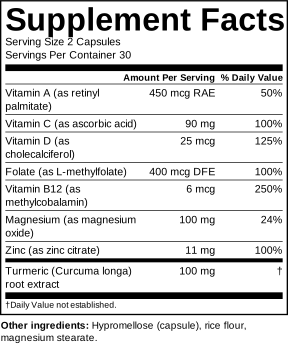
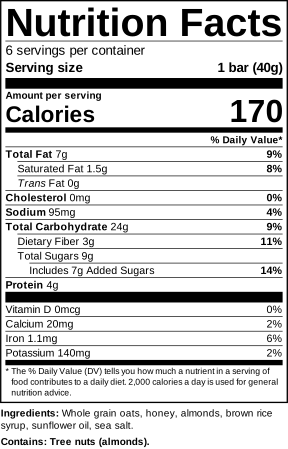
How to decide
- Look at the identity and marketing. If the name, packaging or ads call it a dietary supplement, use Supplement Facts.
- Check for conventional-food cues. Serving it as a drink to replace other beverages, large serving sizes or “refreshment” language points to a food.
- Check the ingredients. Some ingredients are permitted in supplements but not as food additives, and vice versa.
- When in doubt, ask a regulatory consultant. Choosing the wrong framework affects claims, ingredients and manufacturing rules, not just the label.
Ready? Use the supplement facts label maker or the nutrition facts label maker. Both are free.
Frequently asked questions
Can a protein powder use either label?
It depends on how it is marketed. A protein powder sold as a dietary supplement uses Supplement Facts; one sold as a food (e.g. a meal or baking ingredient) uses Nutrition Facts. The choice must be consistent with the product’s intended use, name and claims.
Are energy drinks supplements or beverages?
Many brands moved energy drinks to Nutrition Facts after FDA guidance on liquid products, which says beverages represented as conventional foods should not be labeled as supplements. Review the FDA guidance on distinguishing liquid dietary supplements from beverages.
Do gummies use Supplement Facts?
Gummy vitamins marketed as dietary supplements use Supplement Facts. They usually declare calories, carbohydrate and sugars as well as vitamins, because those are present in measurable amounts.